Week 04 - Thesis Topic Exploration
26 Jan - 01 Feb 2026
Thesis Topic Exploration
Topic 1: Gaussian Splats for Stylized/NPR FX
Concept
Investigate if Gaussian splatting's discrete representation better suits non-photorealistic VFX
(anime smoke, hand-drawn fire, stylized magic) than traditional volume rendering.
Why?
Problem: Volume rendering optimized for photorealism; NPR effects fight against natural smoothnesst
Hypothesis: Gaussian splats' discrete nature naturally matches hand-drawn, stylized aesthetics
Approach
Convert Houdini sims to Gaussian representations
Develop art-direction tools for Gaussian manipulation
Compare quality, workflow, performance vs. volumes
Focus: anime smoke, magical effects, stylized explosions
Topic 2: Real-Time Gaussian Splat Previews for Volume Look-dev
Concept
Use real-time Gaussian splat rendering as fast, accurate preview system for volume look development,
while final renders use traditional high-quality volume rendering.
Why?
Problem: Volume rendering slow (minutes/frame), slowing iteration
Solution: Gaussian previews render in real-time
Approach
Convert volumes to Gaussian representations
Build real-time viewport integration (Houdini plugin)
Artists iterate with instant Gaussian preview
Validate preview accuracy vs. final renders
Measure workflow time savings
Topic 3: AI Style Transfer Tool for VFX Production Pipeline
Concept
Build production-ready style transfer system that solves VFX-specific with temporal coherence using 3D render data,
deep pipeline integration, and real-time interactive workflows.
Why?
Problem: Look development slow/expensive; existing tools lack temporal coherence and pipeline integration
Functions
VFX-Grade Temporal Coherence
3D-aware warping using motion vectors + depth + cryptomatte
Per-object style consistency - characters, background etc.
Depth-stratified application
Pipeline Integration
Nuke plugin with multi-pass render awareness
Render pass preservation
Shot metadata integration
Real-Time Interactive System
Progressive refinement (0.3s - 2s - 10s quality levels)
Semantic region editing
Multi-reference style mixing
Temporal scrubbing preview
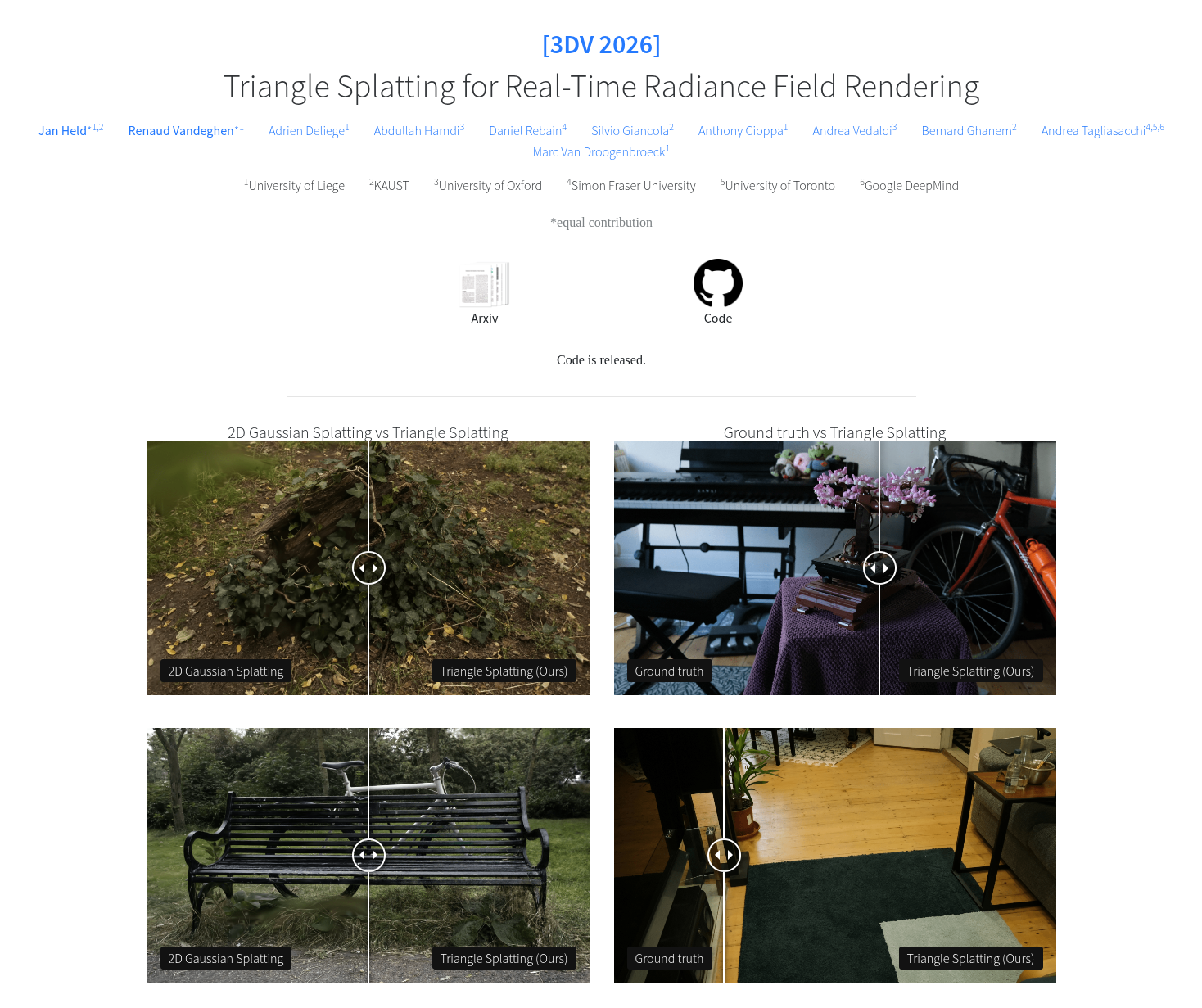
Triangle Splatting Exploration
Create triangle splat from images
Key Innovation
Trains triangle geometry directly from multi-view images
Each triangle has position, orientation, size, color, and opacity
Prerequisites
Python 3.11
CUDA 12.6
Git with submodule support
Input Requirements
Multi-view images (COLMAP format or NeRF synthetic)
Camera poses (from COLMAP or provided transforms.json)
Shot metadata integration
Mesh Export Pipeline
Convert to .OFF Format
Importing to Unreal Engine 5 or any tool supporting .OFF or convertible to .OBJ
Multi-reference style mixing
Temporal scrubbing preview
Triangle Splatting VS Photogrammetry
Triangle Splatting
Handles reflections/specularity better than Photogrammetry
Fewer images needed (can work with gaps)
No texture seams (vertex colors)
Best for complex reflective surfaces (wet, shiny objects) and organic forms (foliage, natural scenes)
Photogrammetry
Geometrically accurate (real-world measurements)
Clean topology
Standard UV textures
Best for architecture/buildings, hard-surface objects (mechanical parts), assets needing manual editing/retopology
To-Do Lists
Use OpenUSD to store multiple variants of style of the same gaussian splat object
Testing original and stylized gaussian splat in Unreal
Refine Gaussian splat style AI transfer tool